
What is mould? Why is it found in properties?
The fact is – and most people are unaware – that mould spores are everywhere at all times. Mould is nature’s way of breaking down organic material.
Mould comes in many different strains. For example, Penicillium – which you may find growing on stale bread, and Stachybotrys – which is the black mould commonly seen in water damaged buildings.
For mould to form there needs to be water present, and organic material – which is the food source for the mould – and the right climatic conditions.
Mould starts off as a single cell and as it grows it forms colonies that decompose the organic material. This process stops when the moisture or food source is removed.
Mould is normally seen as round black dots or patches, or a large dark patch covering the area the mould is colonising.
Our trained mould technicians can attend your property and carry out the correct procedures to rid the area of mould. To start with, we investigate why mould is there.
Where did the water or damp come from and has it been repaired? How long has the mould issue been there? What is the food source, and can it be removed?
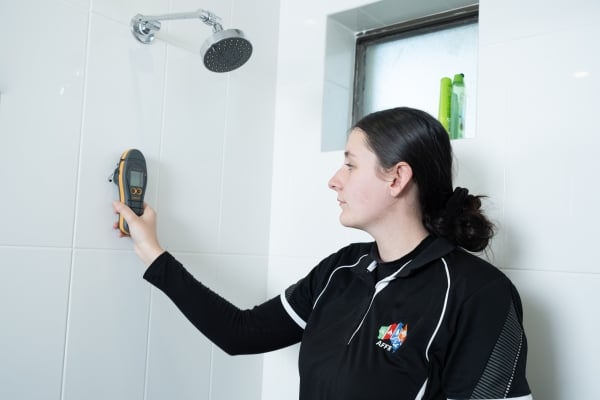
We use our sensitive testing equipment to discover where within the building structure that a leak has occurred.
Our technicians are trained in both mould treatment and building restoration so they can assess the area and make recommendations to solve the issue. Moisture mapping can be carried out as needed.
We may need to take mould samples and send them to the labs for identification to ensure we apply the best restoration process for the problem. We can also carry out quality sampling to compare the outside air to the indoor air if needed.
PLEASE NOTE: Poor ventilation through a house can cause mould to form, especially in bathrooms as the humidity levels rise when water is running in the shower.